MyPetESA guidance
Emotional Support Animal Registration Scams You Should Avoid
Searching for an emotional support animal can quickly lead you to websites offering ESA registration, certificates, badges, ID cards, and “official” emotional support animal documents.
Updated October 14, 2026

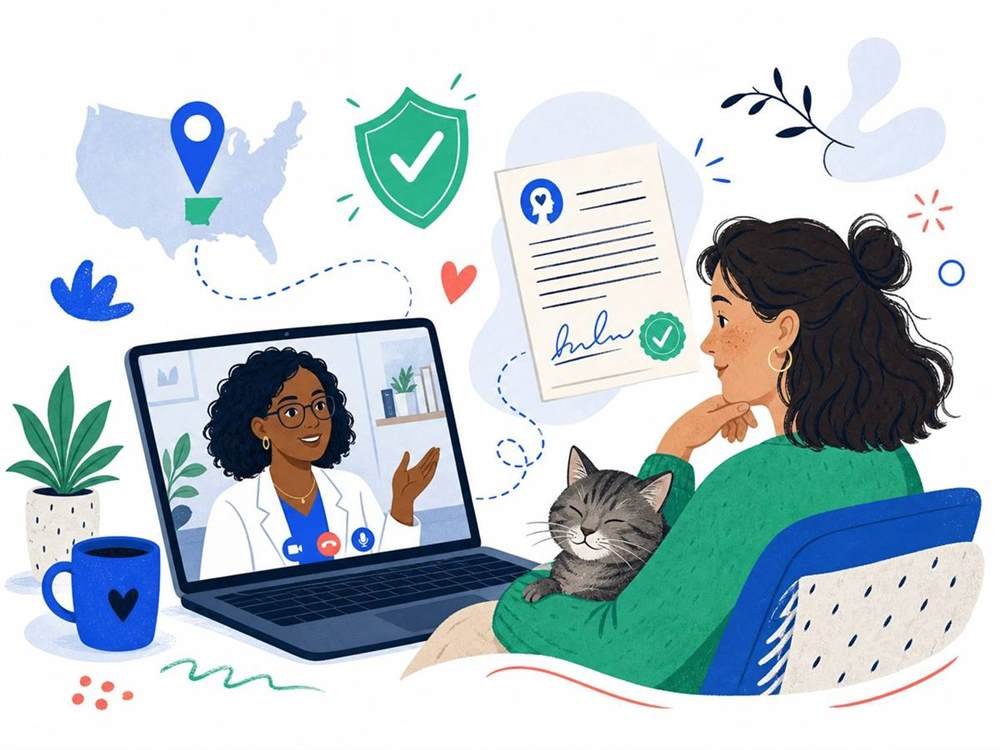
Illustrative stock photo; not actual MyPetESA clients or providers. Photo: Pexels.
Searching for an emotional support animal can quickly lead you to websites offering ESA registration, certificates, badges, ID cards, and “official” emotional support animal documents.
The problem is that these products can create the impression that you must pay for registration or certification before your animal receives housing protections. Under the Fair Housing Act, that is not how the process works.
HUD states that assistance animals are not required to be registered or certified, and that purchased internet registrations and certifications may not provide reliable evidence of a disability-related need.
If you are considering whether to register an emotional support animal, understanding the difference between legitimate healthcare documentation and a simple registration product can help you avoid wasting money.
Is Emotional Support Animal Registration Required?
No. There is no federal Fair Housing Act requirement that you register an ESA in a national database or purchase an ESA certification.
HUD specifically explains that assistance animals do not need to be “registered” or “certified” under the Fair Housing Act. HUD also states that registration or certification generally does not provide a benefit to a person with a disability who needs an assistance animal.
This is an important distinction:
ESA registration ≠ ESA documentation
A registration website may give you an ID number, certificate, or database listing. That does not establish the disability-related need for an assistance animal.
For housing accommodations, the relevant issue is whether the person has a disability and whether the requested assistance animal is needed because of that disability. HUD's current assistance-animal guidance describes the reasonable-accommodation process in those terms.
Common Emotional Support Animal Registration Scams
Not every website offering ESA-related services is necessarily fraudulent. However, certain warning signs should make you stop and investigate before paying.
1. “Register Your ESA in the Official National Database”
Be cautious when a website claims that your animal must be entered into an “official” national ESA database.
There is no federal ESA registration database that you must use to obtain Fair Housing Act protection.
A website-created database, certificate, or registration number should not be confused with a government-issued legal status.
2. “Get Certified Without Speaking to a Healthcare Professional”
Another warning sign is a service that promises an ESA certificate after nothing more than a few questions or an instant checkout.
HUD has specifically expressed concern about websites that sell assistance-animal documentation based on questionnaires or very brief interactions without the provider having personal knowledge of the individual's disability-related need.
A legitimate evaluation should involve an appropriately qualified healthcare professional when professional documentation is needed.
3. “Guaranteed Housing Approval”
Be careful with companies promising that their ESA registration or certificate will guarantee landlord approval.
Housing providers evaluate reasonable accommodation requests under applicable Fair Housing Act rules. HUD explains that reliable disability-related information may be requested when the disability or disability-related need is not apparent, subject to the applicable requirements.
No registration number can turn an otherwise unsupported request into an automatic approval.
4. Fake Government Seals or Logos
A website may display government-looking seals, logos, badges, or language suggesting that it is affiliated with HUD or another federal agency.
That should immediately prompt further research.
HUD previously warned about websites selling assistance-animal documentation and specifically noted concerns about websites implying a federal-government affiliation.
Before paying, check whether the organization actually has the government relationship it claims to have.
5. Expensive “ESA Certification” Packages
Some websites bundle an ID card, certificate, registration, vest, database listing, and other products into an expensive package.
The presence of more documents does not necessarily make an ESA housing request more legitimate.
HUD has stated that certifications and registrations purchased online are not required under the FHA and may not reliably establish a disability-related need.
6. Instant Approval With No Evaluation
An offer such as “Complete this form and receive your ESA certificate immediately” deserves caution.
A legitimate healthcare evaluation is different from purchasing a document.
For an emotional support animal, relevant healthcare documentation should address the individual's disability-related need and the therapeutic support provided by the animal when such documentation is appropriate. HUD recognizes documentation from healthcare professionals who have sufficient personal knowledge of the individual.
Registration, Certification, and an ESA Letter Are Different
These terms are often used interchangeably online, but they do not mean the same thing.
| Term | What it generally means |
|---|---|
| ESA registration | A commercial listing or database entry offered by a private organization |
| ESA certification | A certificate or document claiming that an animal is a certified ESA |
| ESA ID card | An identification card issued by a private service |
| ESA letter | Healthcare documentation addressing a person's disability-related need for an assistance animal |
| Assistance animal accommodation | A housing request evaluated under applicable fair-housing requirements |
The most important distinction is between a commercial ESA product and legitimate disability-related documentation.
HUD states that online certifications and registrations are not required under the FHA.
What Documentation May Actually Matter?
When a disability and the disability-related need for an assistance animal are not apparent, a housing provider may request reliable disability-related information.
HUD identifies examples of potentially reliable information, including documentation from a healthcare professional who has personal knowledge of the individual's disability-related need.
For an animal providing therapeutic emotional support, HUD says the healthcare professional should explain that the animal provides or will provide support that helps the individual cope with identified symptoms or effects of a disability.
That is fundamentally different from simply purchasing an online certificate.
Can You Get ESA Documentation Online?
Yes, online healthcare services can be legitimate.
The fact that an evaluation happens remotely does not automatically make the resulting documentation invalid. HUD explains that a healthcare professional who provides services remotely, including over the internet, may provide reliable verification when the provider has personal knowledge of the individual's disability-related need.
The key question is how the evaluation is performed, not simply whether it happens online.
Be cautious when a website:
- Promises an ESA document without an actual healthcare evaluation
- Claims registration is legally mandatory
- Guarantees landlord approval
- Uses government-looking credentials without a verifiable connection
- Focuses primarily on selling certificates or ID cards
- Makes broad claims that an ESA automatically has access to every public place
What About ESA Registration for Housing?
For housing, the Fair Housing Act may require a housing provider to make a reasonable accommodation for a qualifying assistance animal when the applicable conditions are met.
HUD's current guidance explains that a request may involve reliable disability-related information when the disability and need are not obvious. Housing providers can also consider certain legitimate issues involving the specific animal, such as a direct threat or significant property damage that cannot be addressed through reasonable accommodations.
An ESA registration does not replace this process.
In other words, you do not need to register your emotional support animal simply to make a housing accommodation request.
Do ESA Registration Websites Have Any Legal Authority?
A private company can sell services such as an ID card, database listing, or certificate, but purchasing one does not create a federal legal status for your animal.
HUD's position is particularly clear regarding the Fair Housing Act: assistance animals are not required to be registered or certified, and internet-purchased certifications or registrations may not be reliable evidence of disability-related need.
Therefore, consumers should be skeptical of websites suggesting that paying for their registration gives an animal rights that it otherwise would not have.
How to Check an ESA Service Before Paying
Before purchasing an ESA-related service, ask these questions:
Who performs the evaluation? Look for a qualified healthcare professional rather than a simple certificate generator.
Will I actually speak with the provider? A meaningful evaluation is different from answering a short questionnaire and immediately receiving a document.
What does the service actually provide? Understand whether you are paying for healthcare evaluation and documentation or simply purchasing an ID card, certificate, or database entry.
Does the company claim registration is legally required? This conflicts with HUD's guidance for FHA assistance animals.
Does the company guarantee housing approval? Be cautious of absolute guarantees.
Can the provider be independently verified? Professional credentials should be identifiable and appropriate to the services being provided.
A Better Approach Than ESA Registration
If you believe an emotional support animal may help with a disability, focus on the evaluation and documentation process, rather than purchasing an ESA registration.
A typical legitimate pathway may involve:
- Discussing your circumstances with an appropriately qualified healthcare professional.
- Having your disability-related needs evaluated.
- Receiving appropriate documentation when the provider determines it is warranted.
- Submit a reasonable accommodation request to your housing provider when applicable.
- Following legitimate housing requirements concerning the animal.
HUD explains that assistance animals are not pets under the Fair Housing Act and may qualify for reasonable accommodations when the applicable requirements are satisfied.
How MyPetESA Approaches the ESA Process
MyPetESA focuses on the ESA evaluation and letter process, rather than treating registration as a legal requirement.
The goal is to connect individuals with licensed providers for an evaluation based on their circumstances. If an ESA letter is appropriate, the documentation should reflect the individual's actual disability-related need.
That is very different from simply buying an ESA registration number or certificate.
If you are researching an ESA service, look beyond phrases such as “official registration,” “instant certification,” or “government-approved database.” Understanding what you are actually paying for can help you make a more informed decision.
Helpful answers
Frequently asked questions
Do I need to register my emotional support animal?
No. HUD states that assistance animals are not required to be registered or certified under the Fair Housing Act.
Is ESA registration legally required for housing?
No federal FHA rule requires you to register an emotional support animal in a private database. Housing accommodation requests are evaluated based on applicable Fair Housing Act requirements.
Is an ESA certificate the same as an ESA letter?
No. A certificate or registration may simply be a commercial product. An ESA letter is healthcare documentation addressing a person's disability-related need for an assistance animal.
How can I spot an ESA registration scam?
Watch for claims that registration is legally mandatory, instant approval is guaranteed, no healthcare evaluation is necessary, or a private website is officially affiliated with the federal government.
Can I get an ESA letter online?
Potentially. HUD recognizes that healthcare professionals can provide services remotely when they have sufficient personal knowledge of the individual's disability-related needs.