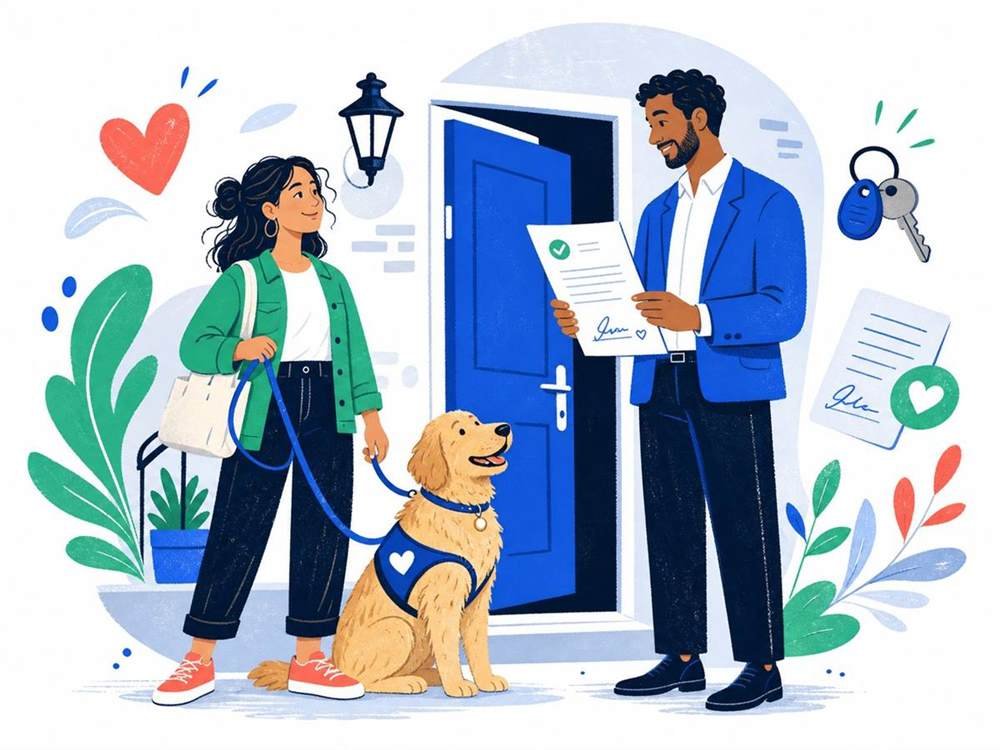

The foundation: the Fair Housing Act
The Fair Housing Act (FHA) requires most housing providers to offer reasonable accommodations for individuals with disabilities. The U.S. Department of Housing and Urban Development (HUD) recognizes emotional support animals as assistance animals when they help alleviate the symptoms of a mental or emotional health condition. Unlike the ADA, the FHA doesn't require ESA animals to receive task training. With a legitimate emotional support animal letter from a licensed mental health professional, most landlords must evaluate your accommodation request, even if the property has a no-pets policy.
What a valid ESA letter unlocks
Live with your emotional support animal in many no-pet apartments, rental homes, condominiums, and HOA communities.
Avoid pet rent, pet fees, and pet deposits for your approved ESA animal (while remaining responsible for any actual damage).
Receive consideration beyond standard breed and weight restrictions, subject to an individual assessment.
Request reasonable accommodation in many college and university housing communities.
What landlords may ask — and what they may not
If your disability-related need isn't obvious, a housing provider may ask for reliable documentation supporting your request. That's where a legitimate ESA letter for housing becomes important. They may verify your emotional support animal letter, and our ESA letter verification service helps confirm authenticity quickly.
Housing providers may not:
Ask for your diagnosis or complete medical records.
Charge fees for reviewing your accommodation request.
Require ESA registration, ESA certification, or ID cards, since no official registry exists.
Require you to use a specific form or template from your clinician.
When a landlord can lawfully say no
The individual animal poses a direct threat to the health or safety of others that can't reasonably be reduced.
The animal would likely cause substantial property damage that can't be prevented through reasonable accommodation.
The property qualifies for a federal exemption, such as certain owner-occupied buildings or eligible single-family rentals.
The documentation isn't reliable, such as letters issued without a proper evaluation by a licensed mental health professional.
Full breakdown with real scenarios: Can a Landlord Deny My ESA?
How to request your accommodation
You can request accommodation before signing a lease, during your tenancy, or after adopting your emotional support animal. Submit a brief written request, attach your ESA letter, explain your disability-related need, and request accommodation under the Fair Housing Act. Keep copies of your communication for your records. Our guide on Talking to Your Landlord About Your ESA provides helpful examples for making the process easier.
Housing providers should review accommodation requests promptly. If your request is unfairly denied, you may file a complaint with HUD or your state's fair housing agency. In addition, several states—including Arkansas, California, Iowa, Louisiana, and Montana—require a 30-day client-provider relationship before a licensed mental health professional can issue an emotional support animal letter. Visit our ESA Laws by State guide for state-specific requirements.
This guide provides general educational information about federal housing protections and is not legal advice. For guidance on your specific situation, consult a qualified fair housing attorney or your local fair housing agency.